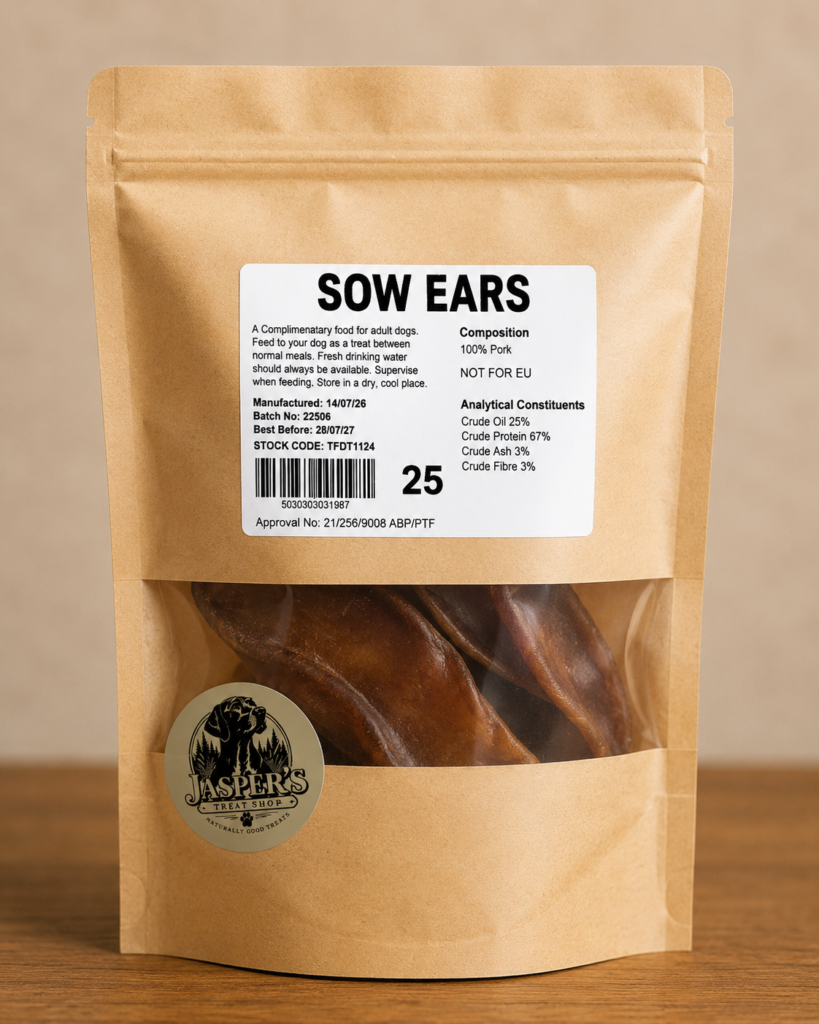
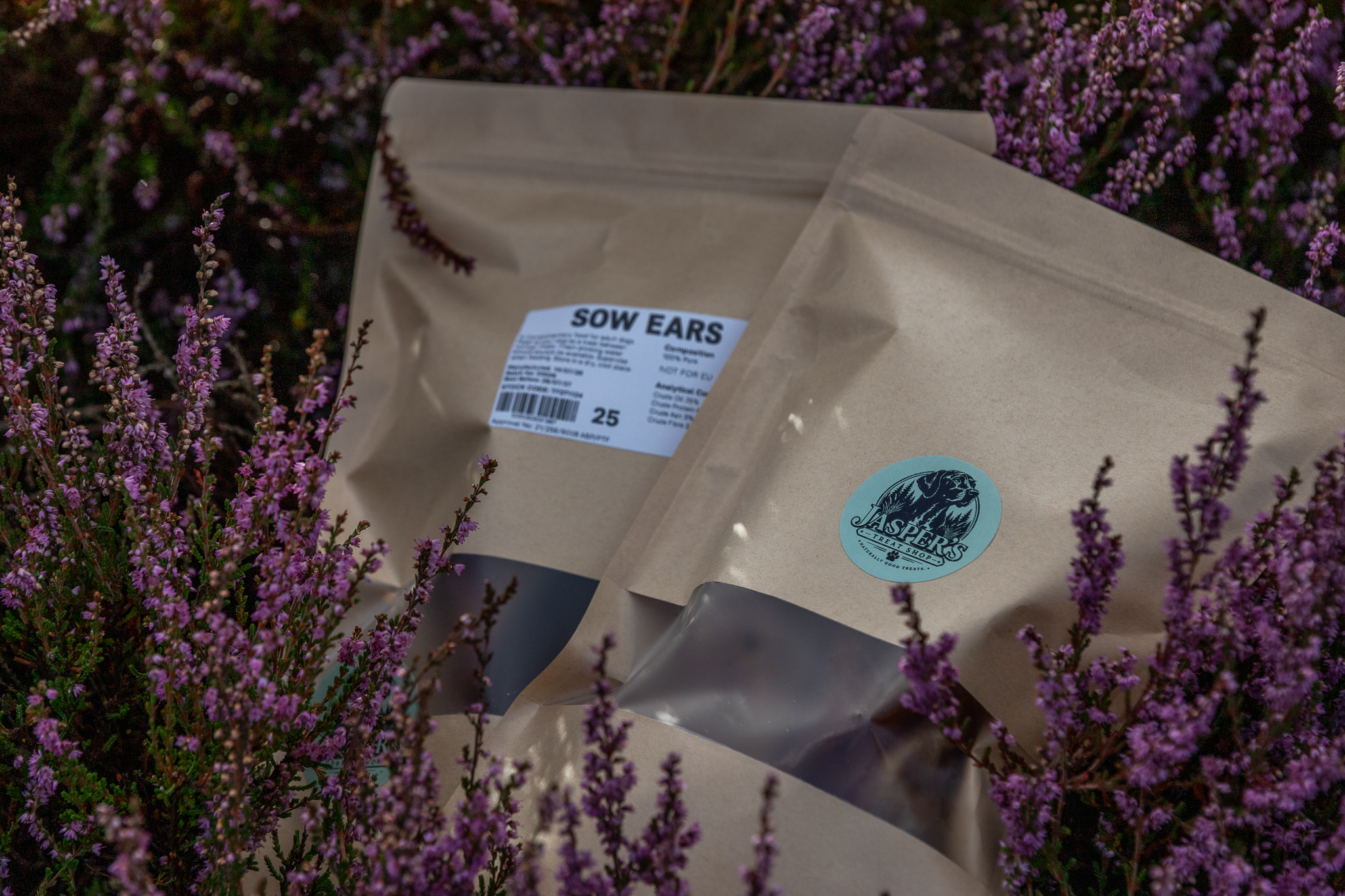
- whole pig ears
- pig ear strips
- pieces or portions
- larger sow ears
Pig ears are one of the most recognisable natural dog treats around.
They’re simple, unmistakably meaty and — judging by the reaction of many dogs when one appears — considerably more exciting than they look to us.
But if you’ve never given your dog a pig ear before, you might reasonably have a few questions.
Are pig ears good for dogs? Are they safe? How often can dogs have them? What about puppies? And what’s the difference between pig ears, pig ear strips and sow ears?
The short answer is that pig ears can be an enjoyable occasional treat for many dogs, but they aren’t suitable for every dog or every situation.
Their size, fat content, your dog’s diet and the way your dog chews all need to be considered.
Here’s what dog owners should know before adding pig ears to the treat cupboard.
What Are Pig Ears for Dogs?
Pig ears sold as dog treats are exactly what the name suggests: ears from pigs that have been prepared and dried to produce a chewable treat.
Depending on the particular product, they may be sold as:
The preparation process varies between manufacturers, which is why it’s important to check the composition and product information for the specific treat you’re considering.
Some products can have very simple compositions, while others may have undergone different processing or contain additional ingredients.
At Jasper’s Treat Shop, we’d always recommend reading the individual product information rather than assuming every pig ear product is identical.
Are Pig Ears Good for Dogs?
For many healthy adult dogs, a suitably sized pig ear can be given as an occasional complementary treat.
Pig ears provide dogs with something different from a small biscuit or training reward. Rather than being swallowed in a couple of seconds, they’re generally chewed and worked on.
However, describing pig ears simply as “good for dogs” is a little too broad.
Whether they’re an appropriate choice depends on the individual dog.
Things worth considering include:
- your dog’s size
- age
- normal diet
- chewing style
- the size of the pig ear
- how frequently they’re given
- any existing dietary or veterinary requirements
Pig ears are a treat, not a replacement for complete dog food.
Think of them as something your dog can enjoy occasionally rather than an essential part of their diet.
Why Do Dogs Like Pig Ears?
We can’t ask them, unfortunately.
Although Jasper would probably be willing to participate in the research.
The straightforward explanation is that pig ears are an animal-based product with a smell, taste and texture that many dogs find appealing.
They also offer something that small training treats don’t:
something to chew.
Chewing can keep a dog occupied with a treat for longer than simply handing them a small reward.
How long is another question entirely.
You’ll sometimes see pig ears and other products advertised as “long-lasting dog chews.”
That’s a claim we’d use carefully.
A small dog that chews methodically may take considerably longer with the same type of treat than a powerful, enthusiastic chewer.
There isn’t a meaningful universal answer to:
“How long does a pig ear last?”
It depends on the ear and, perhaps more importantly, the dog attached to it.
Are Pig Ears Natural Dog Treats?
Pig ears are commonly sold as natural dog treats or natural dog chews, particularly when the product has a simple composition.
But don’t rely on the word “natural” alone.
Read the label.
Check the:
Composition
Analytical constituents
Feeding guidance
Storage instructions
These give you far more useful information about the particular product than marketing terminology by itself.
If a product is described as 100% pig ear, for example, the composition should reflect that.
Individual product pages at Jasper’s Treat Shop provide the available composition and analytical information so you can check before ordering.
Are Pig Ears High in Fat?
This is an important consideration.
Pig ears can contain a significant amount of fat, although the exact analytical values vary between individual products and manufacturers.
That’s one reason we wouldn’t describe pig ears generally as a “low-fat dog treat.”
If fat intake is something you need to monitor for your dog, check the analytical constituents for the particular product before feeding it.
This is especially important if your dog has a health condition or has been placed on a particular diet by your vet.
In those situations, speak to your veterinary professional about appropriate treats rather than assuming a natural product is automatically suitable.
The same applies to portion control.
A whole pig ear and a tiny training treat clearly don’t represent the same amount of food.
How Often Can Dogs Have Pig Ears?
There’s no single frequency that is correct for every dog.
A pig ear should generally be considered an occasional treat rather than something to add to every dog’s daily routine automatically.
How often one is appropriate depends on factors including:
- the size of the dog
- size of the ear
- the dog’s overall diet
- other treats being fed
- activity
- individual dietary requirements
The manufacturer’s feeding guidance for the particular product should always be your starting point.
Remember that treats contribute to your dog’s overall food intake.
If your dog receives lots of training rewards, chews and other extras in addition to normal meals, those extras can add up surprisingly quickly.
Jasper may disagree with the concept of “too many treats”, but fortunately he isn’t responsible for portion control.
Are Pig Ears Safe for Dogs?
No chew is completely risk-free.
Pig ears should be appropriately sized and fed under supervision.
Some dogs chew carefully.
Others attempt to consume anything remotely edible with astonishing efficiency.
Supervising your dog allows you to see how they’re handling the treat and intervene if necessary.
There can be a choking or obstruction risk if a dog attempts to swallow a piece that’s too large, and hard chewing products can also present dental risks depending on the product and dog.
Always:
- supervise your dog while chewing
- provide fresh drinking water
- choose an appropriately sized product
- follow the manufacturer’s feeding instructions
- remove pieces that become an unsafe size where appropriate
If your dog has a history of swallowing treats whole or breaking off and swallowing large pieces, a pig ear may not be the best choice.
What About Bacteria and Hygiene?
This is an area worth knowing about when handling animal-based dog treats.
Pig ears and other animal-derived pet products can potentially carry bacteria such as Salmonella.
This isn’t purely theoretical: public-health agencies have previously investigated human Salmonella outbreaks associated with contaminated pig-ear dog treats.
Good hygiene therefore matters.
After handling animal-based treats:
wash your hands thoroughly with soap and water.
You should also avoid allowing treats to come into contact with food-preparation areas, and take particular care around young children, older people and anyone with a weakened immune system.
Store products according to the manufacturer’s instructions and don’t give your dog a product that appears spoiled or contaminated.
This isn’t a reason to panic about pig ears.
It’s simply sensible hygiene when handling animal-derived pet products.
Do Pig Ears Clean Dogs’ Teeth?
You’ll frequently see claims that natural chews act as a “natural toothbrush.”
Chewing produces mechanical action against the teeth, but we wouldn’t recommend treating a pig ear as a replacement for proper canine dental care.
If you’re concerned about your dog’s teeth or gums, speak to your vet.
Products specifically intended for oral-health purposes should have appropriate evidence supporting those claims.
A pig ear is first and foremost something you’re giving your dog as a treat or chew.
That’s how we’d describe it.
Pig Ears vs Pig Ear Strips
Not every dog needs or suits an entire pig ear.
That’s where pig ear strips can provide another option.
Rather than supplying the whole ear, the product is divided into smaller pieces or strips.
This can make them more convenient when you want a smaller portion than a complete ear.
However, smaller doesn’t automatically mean suitable for every dog.
The same principles still apply:
check the product information, choose an appropriate size and supervise your dog while they’re eating it.
At Jasper’s Treat Shop, our Air Dried Pigs Ear Strips provide another way of exploring pork-based treats without necessarily choosing a complete ear.
What’s the Difference Between Pig Ears and Sow Ears?
This is another question dog owners often have.
A sow is an adult female pig.
Sow ears therefore come from mature female pigs and are often larger and thicker than the pig ears people commonly see sold as dog treats.
That potentially means more chewing material, but again, avoid assuming this guarantees a particular chewing time.
Dog size and chewing behaviour make a huge difference.
For a larger dog or more enthusiastic chewer, a sow ear may offer a different option from smaller pig-ear products.
For a smaller dog, a whole large sow ear may be less appropriate.
Choose based on the individual dog rather than assuming bigger is always better.
Pig Ears vs Other Natural Dog Chews
Pig ears are only one option.
Natural dog chews come in many shapes, sizes, proteins and textures.
Depending on your range, alternatives can include products such as:
- lamb ears
- tripe sticks
- other dried animal products
- different pork chews
- chews from alternative proteins
Rather than searching for one universally “best” natural chew, think about the dog you’re buying for.
Ask:
How big is my dog?
How enthusiastically do they chew?
Do they tend to swallow large pieces?
What proteins do they normally eat?
How substantial do I want this treat to be?
Does the product fit their normal diet?
Those questions are more useful than simply picking whichever chew claims to last the longest.
Can Puppies Have Pig Ears?
This requires more caution than a simple yes or no.
Puppies differ enormously in size, age and stage of development.
A treat appropriate for an older, larger puppy may not be suitable for a very young or small puppy.
The size and firmness of the product also matter.
Before giving a puppy a pig ear:
- check the manufacturer’s feeding guidance
- consider the puppy’s age and size
- choose an appropriately sized product
- supervise them continuously
- provide fresh water
- consider their overall diet
If you’re unsure whether a pig ear or another chew is appropriate for your puppy, ask your vet for advice.
There are plenty of other ways to reward a puppy, so there’s no reason to rush into a particular chew.
Can Dogs With Sensitive Stomachs Have Pig Ears?
This is another area where sweeping claims aren’t helpful.
You’ll sometimes see individual proteins marketed as being suitable for dogs with sensitive stomachs, allergies or intolerances.
But if your dog has known digestive problems, suspected food intolerance, allergies or another medical condition, treat selection should be based on their individual needs.
Don’t assume that something being “natural” makes it appropriate.
Check the complete composition and speak to your vet where necessary.
This is also why Jasper’s Treat Shop avoids casually labelling products hypoallergenic unless there’s appropriate product information to substantiate that claim.
How Should Pig Ears Be Stored?
Always follow the storage instructions supplied with the particular product.
Many dried animal treats need to be kept in a cool, dry place and securely resealed after opening.
Keeping them away from moisture is particularly important.
If you transfer loose treats into another container, make sure the container is clean, suitable for food/feed storage and doesn’t prevent you from retaining the original product identification, batch/traceability and relevant information required for the product.
And keep the treats somewhere your dog can’t reach.
That last point isn’t technically storage guidance.
It’s experience.
What Should You Look for When Buying Pig Ears?
When comparing pig ears online, don’t make your decision solely from the photograph on the front.
Check the product details.
Composition
What exactly is the product made from?
Analytical constituents
Look at the supplied protein, oils/fats, fibre and ash values where available.
Size or quantity
Are you buying a whole ear, multiple ears or strips?
Feeding guidance
Read the manufacturer’s recommendations.
Storage instructions
Know how the product should be stored once it arrives.
Origin/manufacturer information
Buy from a retailer that provides appropriate product information and traceability.
Your dog
Most importantly, consider whether the product is appropriate for the individual dog who will actually be eating it.
How to Introduce a New Dog Treat
If your dog hasn’t had pig ears before, there’s no prize for giving them several at once.
Introduce new foods sensibly.
Offer an appropriate amount and see how your dog responds.
Don’t introduce several completely new treats simultaneously if you’re trying to understand how your dog gets on with a particular product.
And remember that enthusiasm isn’t necessarily evidence that something agrees with them.
Most dogs are considerably more interested in whether something tastes good than whether it represents a sensible dietary decision.
That’s why they employ us.
So, Are Pig Ears Good for Dogs?
For many dogs, pig ears can be an enjoyable occasional treat or chew.
They provide a different eating experience from small training rewards and are available as whole ears, larger sow ears and smaller pig-ear strips.
But they’re not automatically right for every dog.
Their fat content, size, your dog’s overall diet and — particularly — the way your dog chews should all be taken into account.
Our advice is simple:
Read the product information. Choose an appropriate size. Feed treats as part of an appropriate overall diet. Supervise your dog. Keep fresh water available.
And if your dog has particular dietary or health requirements, speak to your vet before introducing a new treat.
That’s far more useful than assuming that every product carrying the word “natural” must automatically be right for every dog.
Can dogs eat pig ears?
Many dogs can have appropriately sized pig ears as an occasional complementary treat. However, suitability depends on the individual dog, its diet, size and chewing behaviour. Follow the product’s feeding guidance and supervise your dog.
How often can I give my dog a pig ear?
There isn’t one frequency appropriate for every dog. Pig ears are best considered an occasional treat, with their size and nutritional composition taken into account alongside your dog’s normal diet and other treats.
Are pig ears high in fat?
Pig ears can contain significant amounts of fat, although analytical values vary between products. Check the analytical constituents of the specific pig-ear product rather than relying on general claims.
Are pig ears suitable for puppies?
Some pig-ear products may be appropriate for some older puppies, but suitability depends on age, size, chewing ability and the individual product. Check its feeding guidance and ask your vet if you’re uncertain.
Do I need to supervise my dog with a pig ear?
Yes. Dogs should be supervised while eating chews and larger treats. Choose an appropriately sized product, provide fresh drinking water and intervene if your dog attempts to swallow unsafe pieces.
What’s the difference between pig ears and sow ears?
A sow is an adult female pig. Sow ears are often larger and thicker than standard pig ears and may therefore provide a different chewing experience. Their suitability still depends on the individual dog’s size and chewing behaviour.